For centuries, psychedelic mushrooms have been used in ceremonial and spiritual contexts. Today, researchers are studying psilocybin with modern neuroscience and clinical methods to better understand how these experiences may influence mood, perception, behavior, and our sense of self.
The research is still evolving—but the findings have created significant interest in psilocybin’s potential role in mental and emotional wellbeing.


Psilocybin is converted in the body into psilocin, which interacts strongly with serotonin receptors in the brain—particularly the 5-HT2A receptor.
These receptors are widely distributed throughout areas involved in perception, cognition, emotion, and our sense of self.
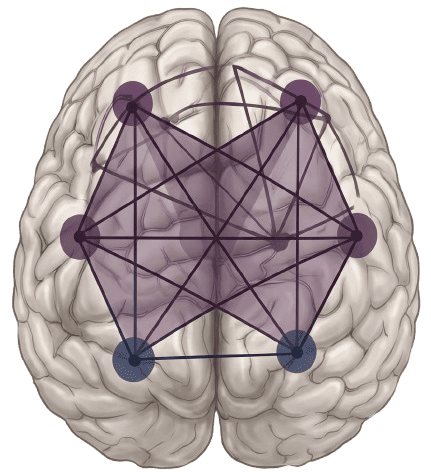
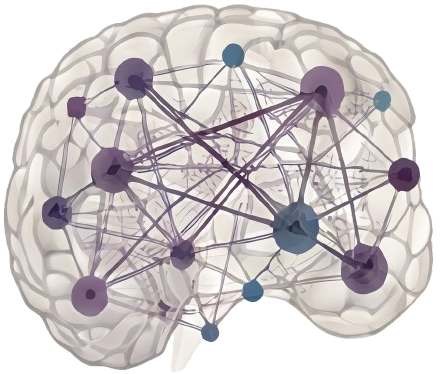
During the psychedelic state, communication patterns across the brain can temporarily change. Networks that usually operate in relatively predictable patterns may become less rigid, while regions that don’t normally communicate as strongly can become more connected.
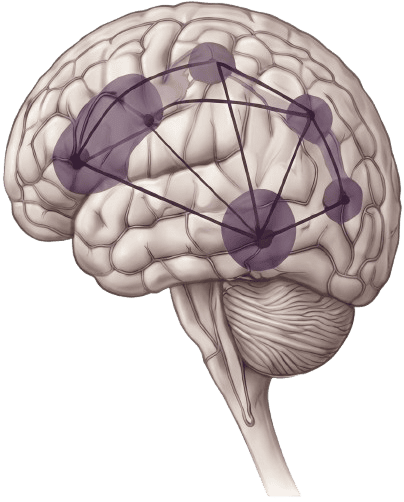
The Default Mode Network is a group of interconnected brain regions that are active when we’re not focused on the outside world.
Our brains are incredibly good at creating patterns. Those patterns allow us to move through life efficiently—but some patterns of thinking, feeling, and responding can become deeply ingrained.
For someone caught in repetitive self-criticism, rumination, fear, or rigid ways of seeing themselves, those familiar mental pathways can begin to feel difficult to step outside of.
Research consistently shows temporary changes in the organization and connectivity of the Default Mode Network.
Activity within the DMN is synchronized, supporting our internal narrative, rumination, and sense of self.
DMN is active and well-connected.
DMN activity decreases and becomes less synchronized.
DMN connectivity decreases, while communication across ordinarily separate brain networks increases.
By temporarily disrupting some of the brain’s usual network organization, psilocybin may create a period in which those familiar patterns become less dominant.
That doesn’t automatically create change.
But it may create space for a different perspective.
Brain-imaging research has found that during the psychedelic state, boundaries between established brain networks can become less distinct. Regions that normally operate independently begin communicating in unusual ways.
This may help explain commonly reported features of psychedelic experiences:
Want to go deeper? Explore current research and clinical studies examining psilocybin, psychedelic experiences, and their potential effects on the brain and wellbeing.

Explore current research on psilocybin and depressive symptoms.

Explore current research on psilocybin and the Default Mode Network.

Explore current research on psilocybin and existential distress.
Disclaimer: This content is for educational purposes only and is not medical advice.
Psilocybin is not approved by the FDA for medical use. Always consult a qualified healthcare professional with questions about your health.